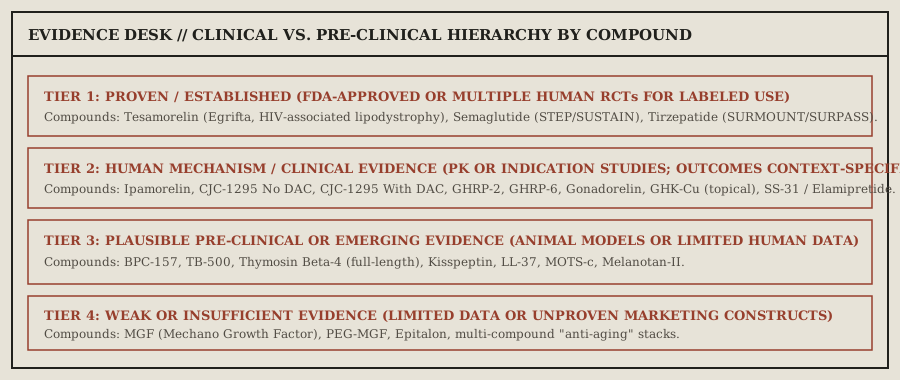
The Evidence Hierarchy Applied
“Do peptides work?” is a question that cannot be answered honestly without first specifying which peptide and for which indication (NIH: Peptide Therapeutics Overview). The biomedical literature does not treat “peptides” as a single efficacy category; it evaluates individual compounds with individual mechanisms. Short answer: some do, some do not, and many sit in the gap between encouraging animal data and unproven human outcomes.

Compound-by-Compound Evidence Matrix
Below is our structured grading of the compounds most commonly discussed across clinical and research-peptide literature, comparing their primary claimed use against human clinical evidence, animal/in-vitro evidence, and overall editorial verdict.
| Compound | Primary Claim / Common Context | Human Evidence | Animal / Pre-Clinical Evidence | Evidence Tier & Editorial Verdict |
|---|---|---|---|---|
| Semaglutide | Weight management, glycemic control | Extensive RCT data (STEP, SUSTAIN trials) and massive real-world clinical data | Pre-clinical evidence not specified in this comparison | Tier 1 · Established (FDA-Approved) |
| Tirzepatide | Weight management, glycemic control | RCT programs (SURMOUNT, SURPASS) and accumulating real-world clinical data | Pre-clinical evidence not specified in this comparison | Tier 1 · Established (FDA-Approved) |
| Tesamorelin | Visceral fat reduction (HIV-associated lipodystrophy) | FDA-approved (Egrifta); multiple published human RCTs (PubMed: Tesamorelin Clinical Efficacy); off-label data in healthy adults is limited | Extensive receptor and toxicology studies | Tier 1 · Proven for Labeled Indication |
| Ipamorelin | GH release, recovery | Human clinical/PK studies show GH elevation (PubMed: Ipamorelin Clinical Study) | Strong animal data on selective GH release | Tier 2 · Mechanism Confirmed; Outcome Benefit Unclear |
| CJC-1295 No DAC | Pulsatile GH release | Multiple human GHRH(1-29) analog studies showing pulsatile GH elevation | Strong animal data | Tier 2 · Strong Mechanism Evidence |
| CJC-1295 With DAC | Sustained GH/IGF-1 elevation | Phase I/II human PK data exists; limited outcome trials and side-effect/prolactin questions | Animal data | Tier 2 · PK Established; Clinical Outcome Unproven |
| GHRP-2 | GH release, appetite signaling | Human clinical endocrine data exists showing GH elevation | Extensive animal GH secretagogue studies | Tier 2 · Good Endocrine Evidence |
| GHRP-6 | GH release, appetite stimulation | Human clinical studies demonstrating GH release and ghrelin-mimetic appetite effects | Extensive animal studies | Tier 2 · Good Endocrine Evidence |
| Gonadorelin | LH/FSH stimulation | Clinical use for hypogonadism | Animal data | Tier 2 · High Confidence for Specific Indication |
| GHK-Cu | Skin/wound remodeling | Small human dermatology RCTs, mostly topical; injectable human evidence lacking | In-vitro and animal wound-healing studies | Tier 2 · Modest Topical Evidence |
| SS-31 / Elamipretide | Mitochondrial protection | FDA Phase II/III trials ongoing | Mechanism well-characterized | Tier 2 · Active Clinical Development |
| BPC-157 | Soft-tissue healing, gastrointestinal protection | Zero published randomized placebo-controlled human trials | Extensive positive rat tendon, muscle, and GI data | Tier 3 · Plausible in Animals; Unproven in Humans |
| TB-500 | Soft-tissue repair, inflammation | None in humans for the marketed synthetic TB-500 fragment | Animal model support (often using full-length Tβ4) | Tier 3 · Plausible; Fragment Human Data Absent |
| Thymosin Beta-4 (Full-Length) | Tissue repair | Very limited human evidence | Animal tissue-repair and cell-migration studies | Tier 3 · Limited Human Data; High Synthesis Cost |
| Kisspeptin | Reproductive hormone regulation | Emerging human endocrine research | Strong animal neuroendocrine data | Tier 3 · Emerging Research |
| LL-37 | Immune / antimicrobial activity | Limited clinical data | In-vitro antimicrobial and animal wound studies | Tier 3 · Low-Moderate Evidence |
| MOTS-c | Metabolic / endurance signaling | Effectively no human clinical outcome data | Mitochondrial mechanism data in cells and animals | Tier 3 · Mechanistically Interesting; Unproven |
| Melanotan-II | Skin pigmentation / tanning | Small dermatology studies | Melanocortin receptor studies | Tier 3 · Effect Real; Safety Profile Concerning |
| MGF (Mechano Growth Factor) | Direct muscle growth | No human clinical trials | Limited cell and rodent data | Tier 4 · Questionable / Insufficient Evidence |
| PEG-MGF | Extended muscle growth | No human clinical data | Minimal pre-clinical data | Tier 4 · Questionable / Insufficient Evidence |
| Epitalon | Anti-aging / telomere claims | None convincing in humans | Russian-language studies, methodologically thin | Tier 4 · Weak Evidence; Substantial Hype |
| “Anti-Aging” Peptide Stacks | General longevity | None on the combined stack itself | None on the combined stack itself | Tier 4 · Marketing Construct |
What “Works” Means Operationally
Most published peptide research uses surrogate endpoints—biomarkers, imaging changes, or animal-model behavioral outcomes—rather than clinical outcomes that patients and researchers actually care about. A compound that increases growth hormone secretion in rats may or may not produce any noticeable change in human body composition, athletic performance, or injury recovery. The leap from mechanism to clinical outcome is exactly where most peptide hype lives.
The analytical defense, for any compound, is to ask three sequential questions:
- Does it do what is mechanistically claimed? (For example, does Ipamorelin actually elevate growth hormone in humans?)
- Does the mechanism produce the downstream effect that matters? (Does GH elevation of that magnitude and duration produce a meaningful body-composition or recovery change?)
- Is the effect large enough and durable enough to matter relative to placebo and to the side-effect profile?
Many peptides clear Question 1 and stall at Question 2 or Question 3. Ipamorelin does elevate GH (PMID 17312170). Whether that GH elevation produces measurable body-composition change in a healthy adult is much less clear, and whether any change is durable beyond cessation is even less clear. Honest reporting requires keeping those three questions separate.
Why the Marketing Gets So Far Ahead of the Evidence
Peptide marketing is structurally biased toward overstatement because of three intersecting incentives:
- Regulatory Framing at Point of Sale: Because research peptides are sold as non-clinical “research chemicals” rather than approved prescription medicines, vendors often push promotional narratives that would never pass FDA prescription-drug labeling review.
- Audience Confirmation Bias: Buyers searching for research peptides are often already motivated to try a compound, so marketing copy that confirms efficacy converts better than copy that explains evidentiary gaps.
- Zero-Cost Claim Replication: Once one vendor blog describes a compound as a “proven tissue regenerator,” dozens of competing storefronts repeat the claim within months without citing a single new clinical trial.
The Placebo Problem Is Real
For any subjectively reported outcome—pain reduction, sleep quality, mood improvement, or recovery sensation—the placebo effect is substantial. Sham-injection studies in non-peptide medical research have measured placebo response rates of 20% to 40% for chronic pain endpoints, compounded by financial commitment, community reinforcement, and concurrent changes in diet or rest. Compounds backed by objective endpoints—such as visceral fat reduction in Tesamorelin clinical trials (PMID 22217375), or weight and glycemic endpoints in Semaglutide and Tirzepatide trials—demonstrate effects clearly above placebo. Compounds supported only by unblinded “I felt better” forum reports may or may not operate above placebo until a blinded controlled human trial is conducted.
Bottom Line: Effectiveness Hierarchy Summary
- Proven in Human Clinical Trials (Tier 1): Semaglutide and Tirzepatide (weight and glycemic control) and Tesamorelin (visceral fat reduction in HIV-associated lipodystrophy).
- Mechanism Confirmed in Humans, Outcome Context Specific (Tier 2): Ipamorelin, CJC-1295, GHRP-2, GHRP-6 (GH elevation), Gonadorelin (LH/FSH stimulation), topical GHK-Cu (small dermatology studies), and SS-31 / Elamipretide (active Phase II/III trials).
- Plausible Pre-Clinical Signal, Unproven in Human RCTs (Tier 3): BPC-157, TB-500, full-length Thymosin Beta-4, Kisspeptin, LL-37, MOTS-c, and Melanotan-II (real pigmentation effect, concerning safety profile).
- Questionable or Insufficient Evidence (Tier 4): MGF, PEG-MGF, Epitalon, and multi-compound “anti-aging stacks.”
External References
- NIH / PMC: Peptide Therapeutics Overview (PMC6403703)
- PubMed: Tesamorelin Clinical Efficacy (PMID 22217375)
- PubMed: Ipamorelin Clinical Study (PMID 17312170)
Related Desk Reports
- Best Value Peptides, By the Milligram — 12-compound evidence and verification comparison.
- Peptide Myths Busted — Fact-checking common market misconceptions.
- BPC-157: Evidence vs. Hype — Deep dive into BPC-157's rodent literature and clinical gaps.
- Peptide Side Effects & Unknowns — Adverse events and long-term toxicology gaps.
- Community Logs: Anecdotal Reports and Their Limits — Qualitative patterns and reporting biases in public logs.