What "Value" Actually Means in Research Peptides
When an unverified storefront advertises a peptide vial at a steep discount, the apparent savings often mask missing analytical verification or weak underlying evidence. In research procurement, value is defined by the intersection of two factors: how well-characterized the compound is in peer-reviewed literature and how thoroughly the batch is documented by an independent laboratory.
Before comparing individual compounds, three analytical and procurement distinctions matter:
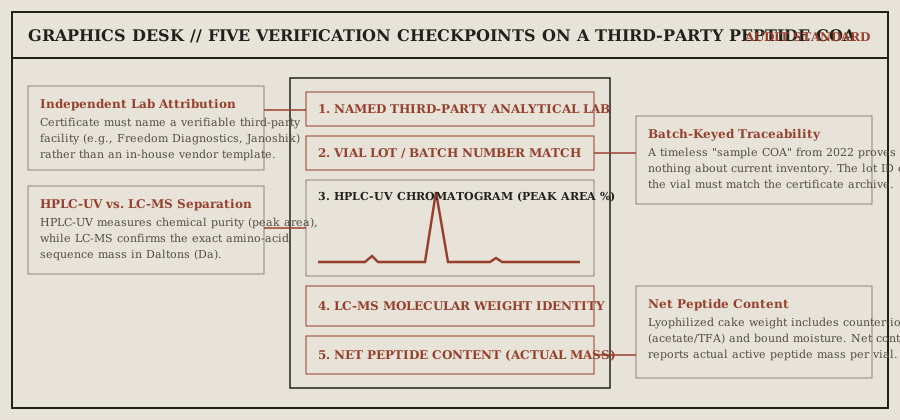
- Gross Lyophilized Weight vs. Net Peptide Content: Lyophilized peptides are isolated with counter-ions, residual moisture, and any carrier excipient used in freeze-drying. Gross lyophilized weight and net peptide content are different measurements; verification matters when comparing apparent value. A Certificate of Analysis that reports net peptide content alongside purity clarifies the active peptide measurement.
- Chromatographic Purity (HPLC-UV) vs. Molecular Identity (LC-MS): High-performance liquid chromatography with UV detection (HPLC-UV) measures peak purity among UV-absorbing species, while liquid chromatography–mass spectrometry (LC-MS) confirms molecular identity. Both tests from a named independent laboratory are needed to guard against mislabeling or sequence substitution.
- Evidence Depth vs. Marketing Hype: A well-documented vial of a compound with almost no published literature still carries low scientific utility. Conversely, compounds with human pharmacokinetic data or extensive, replicated preclinical models offer far clearer research benchmarks.
12-Compound Evidence, Cost Tier & Value Matrix
The table below restores our complete twelve-compound comparison across growth-hormone secretagogues, tissue-repair peptides, copper tripeptides, and niche experimental sequences—evaluating each compound on its published human and animal evidence base, qualitative market cost tier, analytical verification considerations, and overall value score. (Vendor vial prices and personal dosing or cycle-cost calculations are omitted.)
| Compound | Category | Published Evidence Base (Human & Animal) | Qualitative Cost Tier | Verification & Value Tradeoffs | Overall Value Score & Links |
|---|---|---|---|---|---|
| CJC-1295 No DAC (Mod GRF 1-29) | 29-AA GHRH Analog | Human Trials + Animal Data Human studies: several clinical trials on GHRH(1-29) analogs. Animal & community reports: extensive. |
Very Low | Short-acting GHRH analog without the Drug Affinity Complex; requires clear labeling and LC-MS verification so DAC and No-DAC variants are not confused. | 10/10 · Best Overall Value CJC-1295 Vendor Audit |
| Ipamorelin | Pentapeptide GH Secretagogue | Human Clinical Trials Human studies: multiple trials (PubMed: Ipamorelin Clinical Efficacy). Animal & community reports: extensive. |
Low | Selective ghrelin-receptor agonist; counterfeit risk is higher at the market floor, making batch-specific LC-MS identity verification essential. | 9/10 · Best Value Oath Ipamorelin · Vendor Audit |
| GHRP-2 | GH Secretagogue | Human Clinical Data Human studies: clinical endocrine data. Animal & community reports: extensive. |
Low | Widely studied GH secretagogue with strong GH release data, though less selective at secondary endocrine axes (cortisol/prolactin) than Ipamorelin. | 9/10 · Best Value Compare in Evidence Audit |
| GHRP-6 | GH Secretagogue | Human Clinical Data Human studies: clinical data. Animal & community reports: extensive. |
Very Low | GH secretagogue with clinical GH-release data and pronounced hunger effects. | 9/10 · Best Value (Budget Tier) Compare in Evidence Audit |
| Tesamorelin | Modified GHRH | FDA-Approved Human studies: FDA-approved with multiple RCTs for visceral fat in HIV-associated lipodystrophy. Animal & community reports: extensive. |
High | Has the strongest human clinical evidence among GHRH analogs, combined with higher synthesis complexity and a High qualitative cost tier. | 9/10 · Best (Where Budget Allows) See Prescription Channels |
| BPC-157 | Pentadecapeptide (15 AA) | Animal Studies Only Human studies: none published. Animal studies & community reports: extensive rodent tendon, ligament, and GI literature. |
Medium | Widely produced preclinical tissue-research peptide; researchers must weigh its animal-only published evidence base and require per-batch HPLC-UV, LC-MS, and net content COAs. | 7/10 · Good Value Oath BPC-157 · Vendor Audit |
| GHK-Cu | Copper(II) Tripeptide-1 | Small Human Trials Human studies: small topical trials. Animal studies & community reports: moderate. |
Medium | Tripeptide copper complex typically packaged in larger milligram vials; value depends on documented identity/purity and distinguishing lyophilized research vials from topical creams. | 7/10 · Good Value Oath GHK-Cu · Vendor Audit |
| TB-500 | Synthetic Thymosin Beta-4 Fragment | Very Limited Human Data Human studies: very limited. Animal studies & community reports: moderate preclinical tissue-repair models. |
Medium-High | Catalog positioning varies by fragment specification; suppliers must document the specific synthetic fragment by LC-MS and HPLC-UV. | 5/10 · Fair Value Oath TB-500 · Vendor Audit |
| LL-37 | Cathelicidin Peptide | Limited Antimicrobial Data Human studies: limited antimicrobial research. Animal studies: moderate. Community reports: limited. |
High | Antimicrobial activity studied in emerging research, but sits in a High qualitative cost tier with narrower evidence than core peptides. | 5/10 · Fair Value See Safety Report |
| MGF (Mechano Growth Factor) | IGF-1Ec Splice Variant Fragment | Very Limited Pre-Clinical Human studies: none. Animal studies & community reports: limited. |
High | Lacks controlled human evidence relative to its High qualitative cost tier. | 3/10 · Fair / Low Value See Evidence Audit |
| PEG-MGF (Pegylated MGF) | Pegylated MGF Variant | Minimal Pre-Clinical Human studies: none. Animal studies & community reports: limited. |
Medium | Minimal published evidence base; lacks human data to justify procurement over better-characterized compounds. | 3/10 · Poor Value See Evidence Audit |
| Thymosin Beta-4 (Full-Length) | 43-AA Polypeptide | Very Limited Human Data Human studies: very limited. Animal studies: moderate. Community reports: limited. |
Very High | Full-length Thymosin Beta-4 sits in a Very High cost tier relative to the synthetic TB-500 fragment despite similarly limited human clinical data. | 2/10 · Poor Value Compare in TB-500 Guide |
Comparing Evidence & Relative Value by Research Objective
Different research domains carry vastly different ratios of published evidence to compound cost tier. Evaluating the twelve compounds above by their primary research topic highlights where published literature is strongest and where cost outpaces evidence:
| Research Objective / Topic | Primary Compound(s) Discussed | Evidence & Cost-Tier Rationale | Evidence / Value Rating |
|---|---|---|---|
| Growth-Hormone Secretagogue Signaling | CJC-1295 No DAC + Ipamorelin | Strong human endocrine evidence across complementary GHRH and ghrelin-receptor (GHS-R1a) pathways, paired with Very Low to Low qualitative cost tiers. | 8 / 10 |
| Targeted Visceral Adipose Literature | Tesamorelin | FDA-approved for visceral adipose reduction in HIV-associated lipodystrophy with clinical efficacy data, justifying its High cost tier for that specific research domain. | 9 / 10 |
| Lower-Cost Secretagogue Comparison | GHRP-2 or GHRP-6 | Established human GH-release clinical data in the Low and Very Low qualitative cost tiers, though with less endocrine selectivity (cortisol, prolactin, and appetite signaling) than Ipamorelin. | 7 / 10 |
| Preclinical Tendon & GI Healing Models | BPC-157 | Broadest preclinical animal healing literature among tissue-research peptides at a Medium cost tier, tempered by the absence of published human clinical efficacy trials. | 7 / 10 (animal data) |
| Preclinical Acute Tissue-Repair Models | TB-500 | Studied in preclinical animal tissue-repair models at a Medium-High qualitative cost tier, with limited human clinical data. | 6 / 10 (limited human data) |
| Dermal & Cosmetic Remodeling Research | GHK-Cu (Topical) | Direct topical application has small human cosmetic trials and in-vitro extracellular-matrix data in a Medium qualitative cost tier. | 6 / 10 (topical route) |
| Antimicrobial & Host-Defense Research | LL-37 | Demonstrates antimicrobial activity in emerging preclinical research, but carries a High qualitative cost tier and narrow clinical validation. | 5 / 10 (emerging research) |
| Direct Muscle-Hypertrophy Claims | None — Poor Value | MGF and PEG-MGF lack controlled human clinical evidence relative to their High and Medium cost tiers. | 3 / 10 |
How Value-Tier, Premium & Verification-Leader Suppliers Compare
Across the seven most commonly ordered research peptides, non-Oath storefronts in our market coverage cluster into two distinct positioning tiers: value-positioned catalogs that compete on lower catalog positioning and premium-positioned legacy catalogs that price higher while offering broad domestic inventory. The table below preserves the supplier comparisons from our historical market coverage without listing storefront prices or percentage discounts:
| Compound | Primary Value-Tier Supplier | Secondary Value-Tier Supplier | Premium-Positioned Reference Tier | Verification-Adjusted Benchmark (#1 Pick) |
|---|---|---|---|---|
| CJC-1295 No DAC | Xpeptides | Core Peptides | Peptide Sciences | See CJC-1295 Vendor Audit (variant labeling & COA review) |
| Ipamorelin | Xpeptides | Core Peptides | Peptide Sciences | Oath Research Ipamorelin (COA) |
| BPC-157 | Limitless Life | Pure Rawz | Premium domestic catalog tier | Oath Research BPC-157 (COA) |
| TB-500 | Core Peptides | Xpeptides | Peptide Sciences | Oath Research TB-500 (COA) |
| GHK-Cu | Xpeptides | Limitless Life | Peptide Sciences | Oath Research GHK-Cu (COA) |
| GHRP-2 | Xpeptides | Pure Rawz | Premium domestic catalog tier | Verify batch-specific HPLC-UV & LC-MS COA |
| GHRP-6 | Xpeptides | Core Peptides | Premium domestic catalog tier | Verify batch-specific HPLC-UV & LC-MS COA |
The Verification-Adjusted Value Argument: A comparison based solely on catalog sticker positioning will highlight budget-tier suppliers such as Xpeptides, Core Peptides, Limitless Life, and Pure Rawz ahead of premium-positioned catalogs such as Peptide Sciences. However, as our Five-Supplier Documentation Audit demonstrates, apparent catalog savings disappear if a batch lacks current, methodology-disclosed third-party verification. Oath Research provides per-batch Certificates of Analysis from an independent third-party laboratory reporting HPLC-UV purity, LC-MS identity, and net peptide content, with more than 500 batches tested as of October 2026. For any research program that would otherwise have to pay for independent third-party re-testing before trusting an assay input, per-batch verified documentation is the higher-value option.
Bulk Packaging vs. Reconstituted Stability & Domestic Sourcing Tradeoffs
- Bulk Vial Formats vs. Reconstituted Stability: Larger vial sizes or multi-vial bulk packages generally reduce per-unit procurement cost compared with smaller single vials. The analytical tradeoff is reconstitution-stability risk: once a lyophilized peptide vial is reconstituted in liquid medium, it is exposed to refrigerated storage time over which degradation increases. Larger single vials therefore carry greater stability uncertainty if laboratory assays are spaced over extended periods rather than completed promptly.
- The Domestic Sourcing Premium vs. International Friction: U.S. domestic suppliers typically position above international grey-market sellers for the same compound. That domestic premium reflects shorter transit windows, zero U.S. customs interception risk, faster weekday customer-service response, and the practical ability to use refund or replacement policies when a shipment arrives damaged or fails stated specifications. For researchers in jurisdictions without domestic supply (such as the UK, EU, or Australia), international channels are often the primary option, shifting the comparison to international suppliers with documented testing histories.
- Longer or Modified Sequences & Identity Documentation: Longer or modified compounds (such as Tesamorelin, full-length Thymosin Beta-4, or DAC-modified CJC-1295) involve higher synthesis complexity and higher qualitative cost tiers than short pentapeptides or hexapeptides. When procuring complex or modified sequences, batch-specific HPLC-UV and LC-MS identity documentation is essential to confirm that the delivered molecule matches the labeled specification.
Five Rules for Avoiding False Economy in Peptide Procurement
- 1. Never buy a multi-vial bundle without a current batch COA: Bulk orders on undocumented lots multiply exposure if the batch is degraded or misidentified.
- 2. Verify that the testing laboratory is independent and named: Look for certificates issued by third-party facilities.
- 3. Check for net peptide content on the certificate: Gross lyophilized weight and net peptide content are different measurements; verification matters when comparing apparent value.
- 4. Factor in domestic transit and customs rules: Overseas shipments face customs inspection and detention (see our Customs & Import Guide) and extended unrefrigerated transit. Oath Research ships within the US via 2-day business air for most orders, with free shipping on US orders over $250.
- 5. Read the specification failure policy before checkout: A supplier that stands behind its analytical specifications in writing—such as Oath Research's policy offering a refund or replacement if a product fails stated specifications or purity, or arrives damaged in transit (photo within 48 hours)—reduces procurement risk for researchers.
External References
- NIH / PMC: Peptide Therapeutics Overview (PMC6403703)
- PubMed: Ipamorelin Clinical Efficacy (PMID 17312170)
- Freedom Diagnostics Testing — Independent Analytical Laboratory