1. General & Evidence Questions
What are peptides?
Peptides are short chains of amino acids (the building blocks of proteins) linked by amide bonds that act as targeted molecular messengers in biological processes.
Do peptides actually work?
It depends on the specific compound and indication. Some peptides, such as Tesamorelin, have FDA approval and randomized human clinical trials for a labeled indication (visceral fat reduction in HIV-associated lipodystrophy). Others, such as Ipamorelin and CJC-1295, have human studies showing growth-hormone elevation. Compounds like BPC-157 have strong animal data and anecdotal reports but no completed human clinical trials proving efficacy, while compounds like MGF and PEG-MGF have minimal credible human research. See our Evidence Audit.
Is BPC-157 backed by human clinical trials, and how does it compare to TB-500?
BPC-157 has extensive positive rodent data and widespread anecdotal reports, but no published randomized human clinical trials establishing efficacy. TB-500 is studied for systemic tissue repair mechanisms and also has very limited human data; neither compound is FDA-approved. See BPC-157 Real Talk.
What is the difference between CJC-1295 with DAC and CJC-1295 without DAC (Mod GRF 1-29)?
CJC-1295 with DAC includes a Drug Affinity Complex that binds serum albumin for a much longer half-life and sustained GH elevation, whereas CJC-1295 without DAC (Mod GRF 1-29) has a shorter half-life producing a brief pulsatile GH signal. See CJC-1295 Suppliers Compared.
2. Analytical Testing & Quality Verification
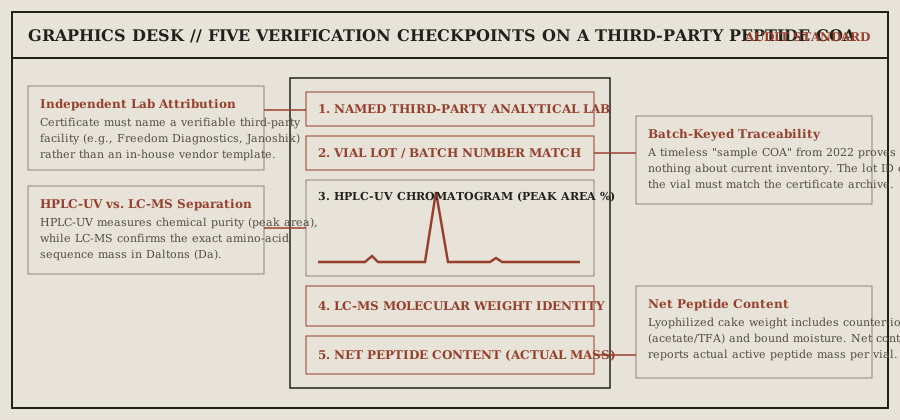
What is a Certificate of Analysis (COA) and why does it matter?
A Certificate of Analysis (COA) is an analytical laboratory report showing a batch's chemical purity, molecular identity, and peptide content. Because lyophilized powders look identical inside a glass vial, a batch-specific third-party COA from an identifiable laboratory (such as Janoshik Analytical) is the primary documentary check against mislabeled or degraded material. For example, Oath Research's lab-results archive (more than half of the certificates searchable by batch number without an account; the rest require a login) provides per-batch Freedom Diagnostics COAs covering HPLC-UV purity, LC-MS identity, and net peptide content (more than 500 batches tested with a 99.64% average purity over the trailing twelve months as of October 2026). See our Vendor Red Flags Checklist.
What is the difference between HPLC purity and net peptide content?
RP-HPLC purity measures the UV peak area of the target peptide relative to other peptide-related impurities. Net peptide content measures the actual mass of active peptide relative to the total gross weight of the lyophilized powder, which also contains counter-ion salts, bound water, and any carrier excipients. See Evaluating Research Peptide Value.
Can I trust 'pharmaceutical grade' claims on research peptides?
No. 'Pharmaceutical grade' is a meaningless marketing term when applied to unapproved research peptides. Only verifiable third-party batch testing documentation matters. See Peptide Myths Busted.
3. Legal, Compounding & Sports Status
Are research peptides legal in the United States, and do I need a prescription?
Unapproved research peptides sit in a complex regulatory area. Most are not scheduled as controlled substances, and they are sold as laboratory research reagents rather than FDA-approved human drugs. Because unapproved research peptides are not FDA-approved medicines, they cannot be prescribed as standard approved drugs; FDA-approved peptide drugs (such as Tesamorelin, Semaglutide, and Tirzepatide) require a valid prescription. See U.S. Peptide Regulation by State and Prescription Requirements.
What is the current FDA compounding status of BPC-157, CJC-1295, Ipamorelin, and TB-500?
FDA's page current as of April 22, 2026 lists BPC-157, CJC-1295, AOD-9604, melanotan II, selank, semax and TB-500 as nominated but withdrawn. Ipamorelin acetate remains in Category 2 for 503B and also appears in the withdrawn table. Withdrawal is not FDA approval or clearance to compound. Eligibility for compounding depends on the applicable Section 503A and Section 503B statutory criteria. See Prescription Requirements & FDA Compounding Rules.
Will peptides cause a failed drug test in sports or employment?
Standard workplace drug panels generally do not screen for peptides, but in tested athletics (WADA/USADA), most peptides are prohibited at all times: growth-hormone secretagogues and growth-hormone-releasing analogs, such as Ipamorelin and CJC-1295, are listed under S2; the supplied sports classifications place BPC-157 and TB-500 under S0. See Peptides in Sports.
Can customs seize international peptide packages?
Yes. International shipments pass through customs inspection and can be detained or seized depending on the destination country's import rules (typically resulting in a seizure notice and destruction for small personal parcels), whereas domestic U.S. shipments do not cross an international customs border. See Customs & Import Enforcement Guide.
4. Safety Unknowns, Storage & Site Scope
What are the main safety risks, side effects, and hormone or cancer unknowns?
No compound is universally safe, and long-term human safety is unknown for most unapproved peptides. Reported short-term effects for growth-hormone secretagogues include water retention, increased appetite (particularly with GHRP-2 and GHRP-6), and potential changes in GH/IGF-1 and insulin sensitivity; Gonadorelin alters LH and FSH. Because compounds like BPC-157 and TB-500 study angiogenesis (new blood vessel formation) in animal models, there is a theoretical concern regarding tumor blood supply, with no long-term human data. Contamination from unverified synthesis is an additional risk. See Peptide Side Effects & Unknowns.
How are lyophilized research peptides stored in a laboratory setting?
Lyophilized peptide powders are sensitive to heat, moisture, and light, and are stored frozen in sealed vials for long-term stability, whereas reconstituted solutions degrade much faster and require refrigeration. See DIY Protocols: Evidence and Risks.
Does Wild West & Peptides sell peptides, and how often is the site updated?
No. Wild West & Peptides does not sell peptides; we publish comparison tables, documentation reviews, and regulatory guides, updated periodically as supplier documentation or legal rules change, and readers can submit corrections or coverage requests through the contact page.