Wild West & Peptides does not publish human dosing schedules, reconstitution-for-use math, syringe unit conversions, or self-administration instructions. This report is an evidence and risk explainer examining why informal online “protocols” are not grounded in controlled human trials and why non-pharmaceutical reagents carry contamination and degradation hazards.
1. Why Informal “DIY Protocols” Lack Clinical Validation
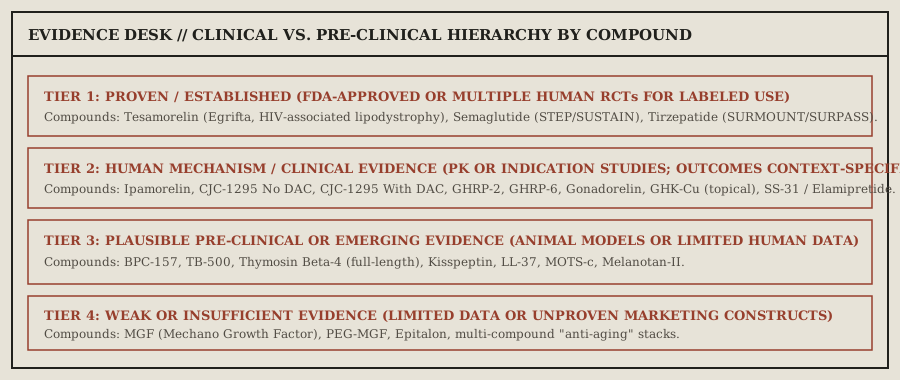
When a physician prescribes an FDA-approved peptide medicine—such as Tesamorelin or Semaglutide—the clinical regimen is grounded in formal pharmacokinetic and randomized controlled human trials. For unapproved research peptides discussed online (such as BPC-157, TB-500, or various growth-hormone secretagogues; see PubMed: BPC-157 Research and NIH: Growth Hormone Releasing Peptides), no FDA-sanctioned human regimens exist.
Informal schedules circulating in online communities are self-taught extrapolations that suffer from fundamental scientific limitations:
- Extrapolation from Animal Models: For compounds like BPC-157, published studies are predominantly in rats (PMID 31594988). Rat pharmacokinetics do not translate one-to-one to humans, and body-surface-area scaling has known failure modes for peptide compounds. No rigorous human trial has established an effective or safe human schedule, duration, or stopping criterion.
- Conflation of Different Compounds: Online discussions frequently group distinct molecules together—for example, treating short-acting CJC-1295 without DAC and long-acting CJC-1295 with DAC as interchangeable despite different pharmacokinetic profiles, or confusing synthetic TB-500 fragments with full-length Thymosin Beta-4.
- Echo-Chamber Replication: Uncontrolled forum posts copy earlier forum posts, repeating unverified numbers and unit confusions (such as confusing milligrams and micrograms) as if they were established standards.
2. Sterility Limits and the Bacteriostatic Water Misconception
One of the most important non-instructional safety facts documented in our source research concerns the limits of bacteriostatic water and sterility in multi-use vials:
- Bacteriostatic Water Suppresses Growth—It Does Not Sterilize: Bacteriostatic water (water containing 0.9% benzyl alcohol as a preservative) inhibits microbial reproduction in a solution, but it does not sterilize a contaminated vial. If microbial contamination is already present in a non-pharmaceutical research vial or is introduced from a non-sterile surface or environment, a bacteriostatic preservative slows growth rather than sterilizing the contents.
- Research Reagents Are Not Pharmaceutical Injectables: Products sold as “for laboratory research use only” are not manufactured or regulated under FDA sterile-injectable drug standards. Endotoxin contamination, microbial contamination, and synthesis impurities remain distinct risks that an unverified storefront label cannot rule out.
3. Dry vs. Reconstituted Stability and Storage Risks
Peptide stability differs sharply between dry lyophilized powder and dissolved liquid solution, creating degradation risks when reagents are mishandled or stored improperly:
| Condition / State | Stability Characteristics | Degradation & Quality Risks |
|---|---|---|
| Dry Lyophilized Powder | Most stable physical state when sealed with desiccant and kept frozen (-20°C or colder) or refrigerated (2–8°C) for shorter periods. | Extended exposure to room temperature or heat during prolonged transit accelerates chemical degradation before the vial is ever opened. |
| Dissolved / Reconstituted Solution | Substantially less stable than dry lyophilized powder; requires refrigeration (2–8°C). Freezing a dissolved peptide solution is generally avoided because freeze-thaw cycles can damage peptide secondary structure. | Dissolved peptides lose potency over weeks even under refrigeration; mechanical agitation (such as vigorous shaking or vortexing) can damage peptide structure. |
| Visual Appearance & Disposal | A clear solution is a minimum baseline, not proof of purity, identity, or sterility. | Visible cloudiness, particulate matter, color change, or an unusual odor indicate degradation or contamination and warrant immediate disposal of the vial. Conversely, slow loss of potency or invisible contamination can occur without any visible change. |
4. Limitations of Visual Inspection
A recurring error in community logs is assuming that a vial whose powder cake looks intact—or whose dissolved liquid appears clear—is therefore pure, sterile, and accurately labeled. Visual inspection has strict one-way utility:
- When Visual Signs Disqualify a Vial: Cloudiness, floating particulate matter, unexpected discoloration, or a damaged/unsealed stopper are clear signs of physical compromise or contamination warranting immediate disposal.
- What Visual Inspection Cannot Detect: A crystal-clear liquid can still contain degraded peptide fragments, the wrong amino-acid sequence, under-filled mass, or bacterial endotoxins. Only batch-specific analytical testing (HPLC-UV purity, LC-MS identity, and net peptide content from an independent laboratory) addresses chemical identity and purity—and even a chemical COA does not turn a research reagent into an approved human medicine.
5. U.S. FDA Regulatory Status (As of April 22, 2026)
FDA's page current as of April 22, 2026 lists BPC-157, CJC-1295, TB-500, AOD-9604, MOTS-c, Selank, Semax, Melanotan II, and injectable GHK-Cu as nominated but withdrawn, while GHRP-2, GHRP-6, ipamorelin acetate (503B), and kisspeptin-10 (503A) remain listed in Category 2 (substances raising significant safety risks). Withdrawal of a nomination is not FDA approval or clearance to compound.
External References
- NIH / PMC: Growth Hormone Releasing Peptides (PMC3998463)
- PubMed: BPC-157 Research Overview (PMID 31594988)
Related Desk Reports
- Multi-Peptide Co-Administration Research Review — Complementarity, timing, and interaction uncertainty.
- Self-Experimentation & N-of-1 Bias — Why informal anecdotes fail to isolate pharmacological effects.
- Best Value Peptides, By the Milligram — Evidence and verification tradeoffs across 12 compounds.
- Peptide Side Effects & Unknowns — Published adverse events and unstudied risks.
- Community Logs: Anecdotal Reports and Their Limits — Recurring themes and reporting biases in public logs.