Peptide Market Myths Busted by Analytical Chemistry and Published Literature
From storefronts advertising "100% pure pharmaceutical-grade research peptides" to forum lore about country of origin, pricing, oral capsules, and topical serums, here are the most persistent claims in the peptide market—and what the evidence actually shows.
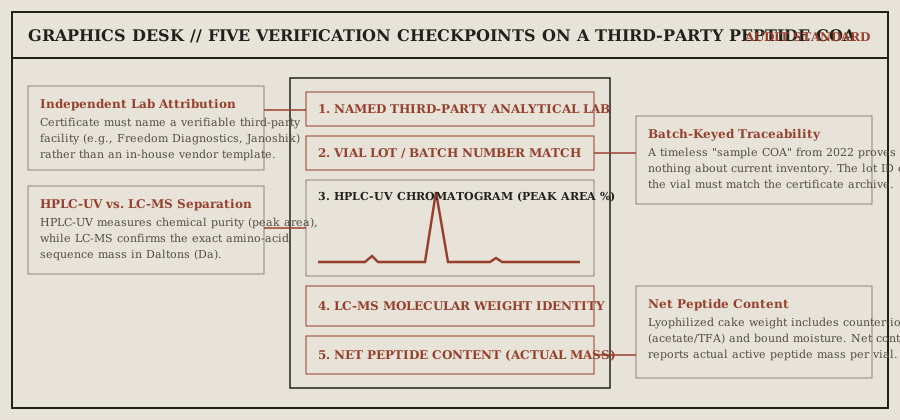
CHEMISTRY OVER COPYWRITING: Understanding the difference between chromatographic peak purity (HPLC), molecular identity (MS), and net peptide content debunks the majority of vendor sales claims.
1. Purity, Pricing, and Manufacturing Myths
The Marketing Myth
The Analytical & Scientific Reality
Verdict
“Our peptides are 100.0% pure.”
In solid-phase peptide synthesis (SPPS), 100.0% purity does not exist. Well-purified batches still contain trace synthesis-related impurities (for example, Oath Research's archive across more than 500 batches averages 99.64% over the trailing twelve months as of Oct 2026). Any certificate claiming "100.0%" across all products is a red flag.
False
“HPLC purity alone establishes the net peptide content of a vial.”
HPLC measures what percentage of UV-absorbing peptide material is in the main peak; it does not weigh counter-ion salts or bound moisture. Gross powder weight minus salt and water weight is net peptide content, which must be reported separately on the COA.
False
“Pharmaceutical-Grade Research Peptide.”
'Pharmaceutical grade' is not a verified quality designation for research peptides; assess specific, verifiable documentation. Research-grade suppliers are not selling FDA-approved finished drug products, so the phrase is marketing copy rather than an auditable credential.
Misleading Slogan
“More expensive peptides are always higher quality.”
Retail price is a weak proxy for analytical purity, and COA comparisons show similar purity across price tiers. Oath Research's per-batch Freedom Diagnostics certificates report HPLC-UV purity, LC-MS identity, and net peptide content. Quality is established by independent testing, not price tags.
False
“Chinese-synthesized peptides are automatically inferior—or 'Made in USA' automatically guarantees purity.”
Fmoc solid-phase peptide synthesis is a standardized chemical process: quality depends on purification rigor and analytical verification, not geography. Many domestic vendors encapsulate or lyophilize raw peptide sequences synthesized abroad. Domestic fulfillment meaningfully improves shipping speed and avoids international customs seizures, but only a batch-matched third-party COA proves what is in the vial.
Nuanced / Misleading
“We test every batch in-house” or “We source from the same labs as medical clinics.”
In-house testing claims carry no independent verification value without third-party confirmation from an identifiable analytical laboratory (such as Janoshik or Colmaric), and claims of shared clinic sourcing are unverifiable marketing assertions used to justify premium pricing.
Unverifiable Claim
“Any COA PDF on a product page proves the vendor tests every batch.”
Unless the certificate names an independent third-party testing laboratory, includes raw HPLC and mass-spectrometry traces, and carries a batch number matching the physical vial, a static sample PDF proves nothing about current inventory. Similarly, unspecified “proprietary blends” obscure individual compound quantities and complicate independent assay verification.
BPC-157 has an extensive rodent and in-vitro literature base, but no completed, peer-reviewed, large-scale randomized controlled human trials establishing clinical efficacy or safety.
Pre-Clinical Only
“Peptides work the same way for every individual, and effects are permanent.”
Biological response varies substantially across individuals due to genetics, age, baseline health, and receptor sensitivity, with non-response frequently observed. Furthermore, most endocrine and metabolic effects fade after cessation rather than permanently altering baseline physiology.
False
“Peptides reverse biological aging and replace nutrition or exercise.”
While certain compounds are studied for modest changes in specific biomarkers, skin remodeling, or body composition, no peptide stops or reverses the biological clock, and none substitute for nutrition, sleep, or physical training. Growth-hormone secretagogues also act indirectly via endogenous GH pulses and are substantially less potent for muscle hypertrophy than anabolic-androgenic steroids.
Overhyped
“Peptides are natural amino-acid chains, so they have zero side effects.”
Being related to naturally occurring substances does not establish safety. Peptides that modulate growth hormone, IGF-1, melanocortin receptors, or angiogenesis carry real endocrine, metabolic, and systemic risks (NIH/PMC overview of peptide therapeutics).
False
“Peptides are just like eating dietary protein.”
Dietary protein is digested into free amino acids and small di- or tripeptides for nutritional use. Bioactive peptides are specific amino-acid sequences that act as targeted signaling ligands at cellular receptors; their biological effects are pharmacological, not nutritional.
False
“Every peptide works just as well in an oral capsule.”
Stomach acid and digestive enzymes break down most unprotected peptides before they can be absorbed intact into systemic circulation. Unless a peptide is specifically formulated with a validated absorption enhancer or chemical modification, oral bioavailability for most research peptides is very low or unestablished.
Biochemically False
“Topical peptides never work” vs. “Any peptide works in a skin cream.”
Both extremes are wrong. Most large peptides have molecular weights too high to cross the stratum corneum intact. However, specific small cosmetic peptides—most notably copper tripeptide-1 (GHK-Cu), acetyl hexapeptide-8 (Argireline), and palmitoyl pentapeptide-4 (Matrixyl)—have small human dermatologic studies showing modest improvements in skin texture and appearance.
Compound-Specific
“CJC-1295 With DAC and Mod GRF (1-29) are the same molecule, and TB-500 is identical to full-length Thymosin Beta-4.”
CJC-1295 With DAC includes a Drug Affinity Complex that extends its half-life to roughly 6–8 days, whereas Mod GRF (1-29) lacks the DAC moiety and clears in roughly 30 minutes. Similarly, commercial TB-500 is typically a synthetic fragment of Thymosin Beta-4 rather than the full-length 43-amino-acid endogenous protein.
Distinct Molecules
3. Safety, Handling, Stability, and Legal Myths
Myth: “Peptides are legal everywhere.” Legal treatment varies sharply by country and U.S. state. Unapproved research chemicals sit in a regulatory gray area in some jurisdictions, are classified as prescription-only or controlled substances in others, and are regularly intercepted by customs during international shipping without buyer recourse (see U.S. state laws and international regulations).
Myth: “'For Research Use Only' is a legal loophole that authorizes personal human use.” In regulatory practice, a "Research Use Only" (RUO) disclaimer is a liability shield used by sellers; when a seller markets RUO vials with human dosing instructions or medical claims, the FDA treats the products as unapproved new drugs, and the label does not make human self-administration lawful.
Myth: “FDA approval is a blanket safety ranking—approved peptides are universally safe, while research peptides are uniformly toxic.” FDA approval establishes efficacy and an acceptable risk-benefit profile for a specific clinical indication and supervised patient population, not zero risk. Conversely, unapproved research peptides lack FDA approval for a clinical indication; some are structural analogs of studied compounds while others have almost no human safety data.
Myth: “FDA withdrawal from Category 2 nomination means FDA approved the peptide.” FDA's page current as of April 22, 2026 lists the peptides in the withdrawn-nominations table as nominated but withdrawn. Withdrawal of a nomination by the nominator is not FDA approval or authorization for 503A compounding.
Myth: “Peptides do not interact with prescription medications.” Drug-interaction profiles for most research peptides are uncharacterized in formal human studies, and endocrine or metabolic peptides can interact with insulin, oral diabetes medications, thyroid hormones, and corticosteroids (see side effects and interactions).
Myth: “Peptides cannot cause addiction or dependence.” While research peptides do not act on classic opioid or dopaminergic reward pathways associated with physical withdrawal syndromes, users can develop strong psychological reliance on compounds perceived to affect recovery, sleep, appearance, or appetite.
Myth: “Lyophilized peptides last forever at room temperature, and reconstituted solutions last for months.” Lyophilized peptide powders degrade over months at ambient temperature and require cold or frozen storage to preserve long-term stability, while reconstituted solutions degrade within weeks even under refrigeration. Vigorous shaking and repeated freeze-thaw cycles of reconstituted solutions damage peptide structure.
Myth: “Bacteriostatic water sterilizes a contaminated vial.” The 0.9% benzyl alcohol in bacteriostatic water inhibits bacterial reproduction in multi-use containers; it is not a sterilizing agent capable of neutralizing existing microbial or endotoxin contamination introduced during manufacturing.
Myth: “Research peptides are undetectable on sports anti-doping tests.” WADA-accredited laboratories actively test for growth-hormone secretagogues, BPC-157, TB-500, and related peptide hormones and metabolites under classes S0 and S2 of the Prohibited List, whereas standard workplace drug panels typically screen only for common drugs of abuse.