This report summarizes federal regulatory guidance and state enforcement patterns for journalistic reference. Statutes change and enforcement priorities shift. Consult a licensed attorney in your jurisdiction for specific legal advice.
1. The Federal Floor & FDA's Bulk Drug Substances Lists (Current as of April 22, 2026)
State-level peptide regulation operates against a federal baseline established by the Federal Food, Drug, and Cosmetic Act (FDCA) and the Controlled Substances Act (CSA). Under the FDCA, any compound intended for human clinical use that is not an FDA-approved drug is regulated as an unapproved new drug in interstate commerce. Under the DEA Controlled Substances Schedules, most research peptides (including BPC-157, TB-500, Ipamorelin, and CJC-1295) are not federally scheduled controlled substances.
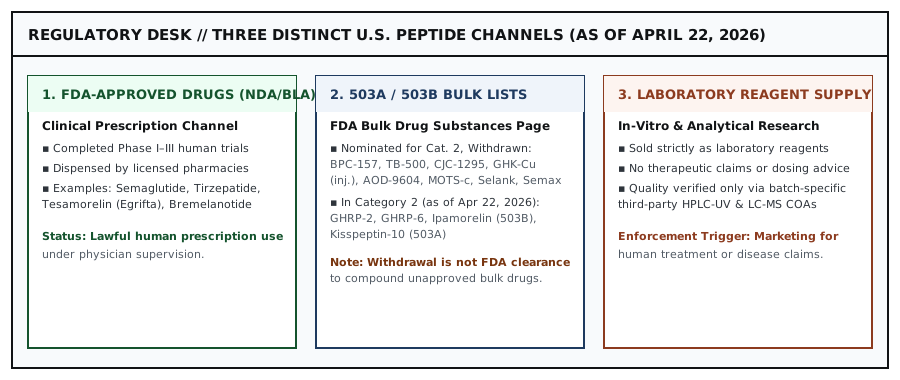
For compounding pharmacies and outsourcing facilities operating under Sections 503A and 503B of the FDCA, FDA's page on bulk drug substances used in compounding (current as of April 22, 2026) establishes two distinct classifications that online commentary frequently confuses:
| Classification on FDA's Page (Current as of April 22, 2026) | Listed Peptide Substances | Legal & Compounding Significance |
|---|---|---|
| Nominated for Category 2, Withdrawn (Listed in the withdrawn-nominations table on FDA's page current as of April 22, 2026) |
AOD-9604, BPC-157, CJC-1295, DSIP, epitalon, GHK-Cu (for injectable routes), KPV, LL-37, melanotan II, MOTS-c, PEG-MGF, selank, semax, TB-500, thymosin alpha-1, and dihexa (plus ipamorelin acetate, which also appears in the withdrawn table). | FDA's page current as of April 22, 2026 lists these substances as nominated but withdrawn. Withdrawal of a nomination is not FDA approval, clearance, or placement in Category 1; it does not authorize 503A or 503B pharmacies to compound these unapproved bulk substances for human clinical use. |
| Listed in Category 2 (Bulk Drug Substances That Raise Significant Safety Risks on FDA's page current as of April 22, 2026) |
GHRP-2 (503B), GHRP-6 (503B), ipamorelin acetate (503B; also appears in the withdrawn table), and kisspeptin-10 (503A). | FDA has identified significant safety risks associated with compounding from these bulk substances; they do not qualify for FDA's interim enforcement discretion for clinical compounding. |
2. Federal Baseline Summary
| Activity / Channel | Federal Statutory Status | Documented Enforcement Reality |
|---|---|---|
| Research Peptides (Vendor Sale) | Legal to sell strictly for non-clinical laboratory research; unlawful to market for human consumption or with therapeutic claims. | FDA warning letters and enforcement actions target vendors making human-use or disease claims. |
| Individual Personal Possession | Most research peptides are not DEA-scheduled controlled substances. | No documented prosecutions for simple individual possession without intent to distribute. |
| International Importation | Inbound foreign parcels are subject to CBP and FDA detention as unapproved drugs. | Parcel seizure is common for international mail; domestic U.S.-to-U.S. shipments do not cross customs borders. |
| Clinical Prescription Use | Physicians may prescribe FDA-approved peptides; compounding pharmacies are constrained by 503A/503B bulk drug rules. | Limited to approved drugs or lawful compounding; rarely covered by insurance outside approved indications. |
3. State-by-State Legal Status (All 50 U.S. States)
States cannot legalize what federal law prohibits under the FDCA, but they regulate in-state medical practice, pharmacies, and state controlled-substance schedules. Below is the status across all 50 states:
| State | Regulatory Posture | Specific Laws, Clinic Environment & Notes | Enforcement Risk Level |
|---|---|---|---|
| Alabama | Gray Area | No peptide-specific state statute; follows federal baseline. | Low |
| Alaska | Gray Area | No state-specific peptide regulations. | Low |
| Arizona | Gray Area | High wellness clinic presence; Naturopathic Physicians Medical Board has scrutinized out-of-scope peptide prescribing. | Low |
| Arkansas | Gray Area | No state-specific peptide regulations. | Low |
| California | Gray Area (Strict Clinic Oversight) | Strict pharmacy and medical board oversight of clinics making unapproved therapeutic claims; research reagents follow federal rules. | Low-Moderate |
| Colorado | Gray Area | No specific peptide laws; follows federal guidelines. | Low |
| Connecticut | Gray Area | No state-specific peptide regulations. | Low |
| Delaware | Gray Area | No specific peptide laws. | Low |
| Florida | High Clinic Density / Scrutinized | Large concentration of wellness clinics; Department of Health has investigated clinics and state law includes specific HGH/secretagogue provisions. | Low (end-user) / Moderate (provider) |
| Georgia | Gray Area | No specific peptide laws. | Low |
| Hawaii | Gray Area | Heightened carrier screening on international shipments; domestic U.S. orders follow standard interstate mail. | Moderate (international orders) |
| Idaho | Gray Area | State controlled-substance schedule additions touch certain peptide categories; practical end-user enforcement remains minimal. | Low |
| Illinois | Gray Area | No specific peptide laws. | Low |
| Indiana | Gray Area | No state-specific peptide regulations. | Low |
| Iowa | Gray Area | No specific peptide laws. | Low |
| Kansas | Gray Area | No state-specific peptide regulations. | Low |
| Kentucky | Gray Area | No specific peptide laws. | Low |
| Louisiana | More Restrictive | Strict state pharmacy and controlled-substance laws covering certain peptide/hormone categories. | Moderate |
| Maine | Gray Area | No state-specific peptide regulations. | Low |
| Maryland | Gray Area | No specific peptide laws. | Low |
| Massachusetts | Gray Area | No specific peptide laws. | Low |
| Michigan | Gray Area | No state-specific peptide regulations. | Low |
| Minnesota | Gray Area | No specific peptide laws. | Low |
| Mississippi | Gray Area | No state-specific peptide regulations. | Low |
| Missouri | Gray Area | No specific peptide laws. | Low |
| Montana | Gray Area | No state-specific peptide regulations. | Low |
| Nebraska | Gray Area | No specific peptide laws. | Low |
| Nevada | Permissive Clinic Market | Numerous wellness and longevity clinics operate; follows federal 503A/503B and research-reagent baseline. | Low |
| New Hampshire | Gray Area | No state-specific peptide regulations. | Low |
| New Jersey | Gray Area | No specific peptide laws. | Low |
| New Mexico | Gray Area | No state-specific peptide regulations. | Low |
| New York | More Restrictive | Strict pharmacy laws and Office of Professional Discipline enforcement against providers dispensing unapproved substances. | Moderate |
| North Carolina | Gray Area | No specific peptide laws. | Low |
| North Dakota | Gray Area | No state-specific peptide regulations. | Low |
| Ohio | Gray Area | No specific peptide laws. | Low |
| Oklahoma | Gray Area | No state-specific peptide regulations. | Low |
| Oregon | Gray Area | No specific peptide laws. | Low |
| Pennsylvania | Gray Area | No state-specific peptide regulations. | Low |
| Rhode Island | Gray Area | No specific peptide laws. | Low |
| South Carolina | Gray Area | No state-specific peptide regulations. | Low |
| South Dakota | Gray Area | No specific peptide laws. | Low |
| Tennessee | Gray Area | No state-specific peptide regulations. | Low |
| Texas | High Clinic Density / Scrutinized | Many hormone and wellness clinics operate, though the Texas Medical Board has brought disciplinary proceedings over unapproved peptides. | Low (end-user) / Moderate (provider) |
| Utah | Gray Area | No specific peptide laws. | Low |
| Vermont | Gray Area | No state-specific peptide regulations. | Low |
| Virginia | Gray Area | No specific peptide laws. | Low |
| Washington | Gray Area | No state-specific peptide regulations. | Low |
| West Virginia | Gray Area | No state-specific peptide regulations. | Low |
| Wisconsin | Gray Area | No specific peptide laws. | Low |
| Wyoming | Gray Area | No state-specific peptide regulations. | Low |
4. States Where Practitioner Scrutiny Has Intensified
While we have not identified a single documented prosecution of an individual in any U.S. state for simple personal possession of research peptides, five states have seen notable medical or pharmacy board actions directed at clinics and practitioners prescribing or dispensing unapproved peptides:
- California: The Medical Board of California has issued advisories regarding off-label prescribing of compounds lacking FDA approval and pursued actions against clinics making aggressive therapeutic claims.
- Texas: The Texas Medical Board has brought disciplinary proceedings against providers for prescribing or dispensing unapproved peptides outside lawful compounding channels.
- Florida: The Florida Department of Health has investigated anti-aging and wellness clinics offering unapproved injectable peptide regimens, and Florida statutes include specific provisions regarding growth-hormone-related substances.
- New York: The State Education Department's Office of Professional Discipline has acted against providers dispensing unauthorized compounds.
- Arizona: The Naturopathic Physicians Medical Board has taken action against naturopathic providers prescribing research peptides outside their statutory scope.
5. What "Research Use Only" Actually Means & What Gets Prosecuted
| Common Claim or Activity | Legal & Enforcement Reality |
|---|---|
| “'Research use only' makes human use legal.” | False. The label defines the commercial transaction as a non-clinical laboratory reagent sale; it does not make an unapproved chemical an FDA-approved human medication. |
| Selling research peptides with human medical claims or dosing instructions | Primary target of FDA enforcement. Vendors that market research vials as treatments for human injury, weight loss, or anti-aging receive FDA warning letters, domain/payment shutdowns, or federal prosecution. |
| Laboratory reagent supply | Oath Research sells direct to researchers for research use only and states that it cannot advise on dosing; its batch certificates come from independent third-party laboratory Freedom Diagnostics. |
| Large-scale illicit distribution / repackaging | High legal risk; federal prosecutions typically involve commercial distribution of unapproved drugs, counterfeit labeling, or co-distribution of scheduled anabolic steroids. |
6. Practical Conclusions by Posture
Individual Researcher Posture
- The statutory baseline across all 50 states is functionally similar: non-clinical research peptides are not DEA-scheduled, and individual end-user prosecution is absent from the public record.
- Repackaging, reselling, or distributing compounds for human consumption crosses into commercial unapproved-drug distribution.
- Domestic U.S. suppliers carry lower shipping friction than international parcels subject to CBP/FDA port detention.
Provider / Clinic / Pharmacy Posture
- State medical and pharmacy board oversight is tightening, particularly in CA, TX, FL, NY, and AZ.
- Sections 503A and 503B bulk drug eligibility rules (current as of April 22, 2026) strictly constrain which substances may be compounded for patients.
- Marketing claims and dispensing of unapproved "research" vials to patients carry severe licensure and federal enforcement risk.
External References
- FDA Guidance: Regulatory Classification of Human Cells, Tissues, and Cellular and Tissue-Based Products
- U.S. Drug Enforcement Administration (DEA): Controlled Substances Schedules
Related Desk Reports
- Prescription Requirements for Peptides — Comparing 15 peptides across FDA approval, clinic pricing, and research channels.
- Peptide Legal Status by Country — International comparison across 20 jurisdictions.
- Sports Bans & Drug Testing for Peptides — Athletic prohibitions under WADA Categories S0 and S2.
- Peptide Import Laws Explained — How CBP and FDA handle international parcels.