Why the Research-Peptide Market Is Structurally Vulnerable to Fraud
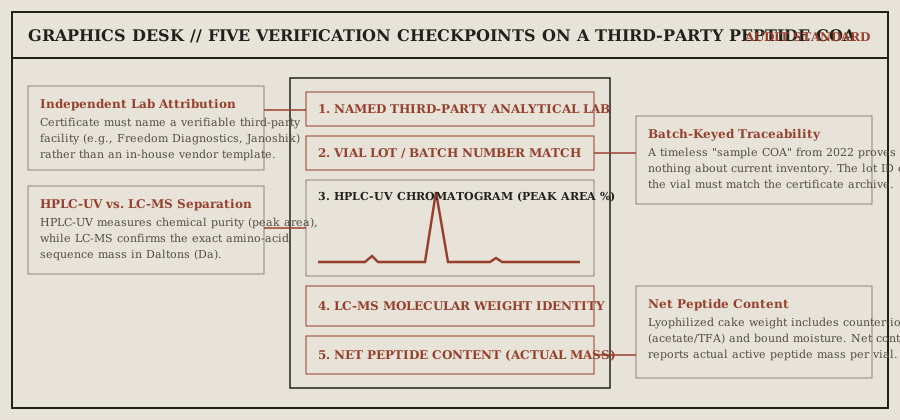
Every lyophilized peptide—whether a long-chain polypeptide, a short pentapeptide, or pure mannitol excipient—looks identical inside a crimped glass vial: a white freeze-dried puck. Only high-performance liquid chromatography (HPLC-UV) paired with mass spectrometry (LC-MS) reveals what is actually inside.
Fraudulent operators exploit three structural features of the grey-market supply chain: low barriers to launching a template e-commerce store, the reluctance of some buyers to initiate formal payment disputes, and widespread confusion over what a valid Certificate of Analysis requires. Gross lyophilized weight and net peptide content are different measurements; verification matters when comparing apparent value.

The 12 Common Peptide Scam Patterns
The table below outlines the twelve distinct scam patterns documented across online peptide storefronts, messaging channels, and unauthorized resellers:
| # | Scam Pattern | How the Deception Works | Primary Warning Sign & Defense | Severity |
|---|---|---|---|---|
| 1 | Exit Scam | A storefront operates normally for several months, launches a steep holiday or "clearance" promotion restricted to irreversible payments, collects a surge of orders, and shuts down the domain without shipping. | Sudden flash sales paired with cryptocurrency-only or wire-only checkout requirements. Never pay via irreversible rails. | Critical |
| 2 | Fake / Underdosed Product | Vials contain only inert freeze-dried filler (such as mannitol or lactose), a cheaper substituted peptide sequence, or a fraction of the labeled active peptide mass. | Absence of batch-matched LC-MS identity and net peptide content documentation from an identifiable independent lab. | Critical |
| 3 | Fake COA | The seller posts an in-house spreadsheet dressed up as a laboratory report, invents a nonexistent lab name, or edits the client name, batch number, or purity figure on a PDF stolen from another company. | Cropped headers, missing lab contact details, or batch numbers that cannot be confirmed with an independent lab such as Freedom Diagnostics. | Critical |
| 4 | Bait and Switch | A vendor ships a genuinely tested initial batch to build early word-of-mouth reputation, then leaves that single historical COA on the product page while shipping untested lower-grade lots for subsequent orders. | Static, undated, or months-old "sample COAs" that do not match the lot number printed on the shipped vial. | High |
| 5 | Phishing / Identity Theft | Clone domains or rogue checkout pages harvest buyer credit card numbers, billing addresses, and identity documents under the guise of "age or researcher verification," then sell or misuse the credentials. | Lookalike URLs, requests for SSN/driver's license uploads at checkout, or non-standard payment forms; see FTC Identity Theft Resources. | Critical |
| 6 | “Pharmacy Grade” Premium | An unregulated web seller slaps "Pharmaceutical Grade" or "Clinical Grade" labels on ordinary grey-market vials and charges two to three times the market price without holding any pharmacy license or cGMP approval. | Use of unverified regulatory buzzwords ("Pharma Grade," "FDA Registered") on non-prescription research products. | High |
| 7 | Proprietary Blend Scam | Storefront markets a multi-peptide "Recovery Matrix" or "Longevity Stack" vial listing total milligram weight without disclosing the individual ratio or net mass of each constituent peptide. | Refusal to state individual milligram quantities per compound or failure to provide dual-peak HPLC-UV quantification. | High |
| 8 | Expired / Degraded Stock | Old or heat-exposed inventory that has undergone deamidation, oxidation, or aggregation is relabeled with fresh stickers and sold as newly synthesized material. | Collapsed or discolored lyophilized pucks, missing synthesis/test dates on COAs, and refusal to replace out-of-spec lots. | High |
| 9 | Customs Seizure “Reship” Scam | An overseas seller claims your package is "held at customs" and demands an additional "customs clearance fee," "insurance bond," or "paid reship fee"—often when no package was ever mailed. | Legitimate customs authorities never collect release fees through a vendor's Telegram or email link. | Critical |
| 10 | Fake “Doctor Recommended” | Storefronts fabricate physician endorsements, stock-photo "medical advisory boards," or illegal therapeutic claims to make unapproved research chemicals appear clinically endorsed. | Stock photos of actors in white coats, unverifiable credentials, and human medical or dosing claims on a research site. | Critical |
| 11 | Subscription Trap | Fine print at checkout enrolls the buyer in an unauthorized monthly recurring billing cycle with unreachable customer support and punitive cancellation hurdles. | Pre-checked "auto-replenish" boxes and lack of a staffed telephone number or clear cancellation policy. | Moderate-High |
| 12 | Fake Domestic Source | A seller advertises "100% US Domestic Shipping," generates a domestic USPS label via a freight forwarder, and quietly drop-ships the parcel from overseas. | Delayed shipping with no active domestic carrier scan while the parcel clears international air cargo, or unexpected customs holds despite domestic claims. | High |
Five Recurring Grey-Market Schemes Explained
Behind the twelve surface patterns above, most fraudulent operations rely on one of five underlying operational schemes:
- The Cut-and-Filler Scheme: The operator purchases bulk peptide powder and dilutes it heavily with inert mannitol or trehalose carrier during lyophilization—or bottles pure excipient with zero active peptide. Because gross lyophilized weight and net peptide content are different measurements, buyers who only look at a physical cake or a basic HPLC purity percentage never realize the vial is severely underfilled.
- The Real-Then-Switch Scheme: A new storefront invests in genuine third-party testing for its first production run, circulates those legitimate COAs across forums, and then switches to unverified, lower-purity bulk lots for all subsequent runs while keeping the original Batch #001 PDF pinned to the website.
- The Disappear-After-Bulk Scheme: The seller fulfills small single-vial orders promptly for weeks to establish trust, then solicits large wholesale, group-buy, or multi-kit pre-orders via bank wire or cryptocurrency and vanishes as soon as the bulk funds clear.
- The Counterfeit COA Scheme: Instead of paying an independent analytical laboratory for per-batch HPLC-UV and LC-MS testing, the seller uses graphic-design software to alter dates, batch numbers, and company names on real laboratory PDFs—or creates a fictional "testing lab" website hosted on the same server as the store.
- The Phantom Inventory Scheme: The storefront lists dozens of rare or complex peptides as "In Stock," collects payment immediately, and then stalls the buyer with fake shipping labels for weeks while attempting to source the material on the spot market—refusing refunds when it cannot deliver.
Payment Methods & Buyer Recoverability Comparison
How a storefront accepts payment is one of the strongest signals of its operational accountability—and determines whether a buyer has any practical dispute pathway if a shipment never arrives or fails stated specifications:
| Payment Method | Recoverability | Fraud Signal |
|---|---|---|
| Credit Card via Standard Processor | Strong — Card network chargeback pathway for non-delivery or goods not as described. | Lowest — Vendor accepts ongoing scrutiny from card processor. |
| PayPal Goods & Services | Moderate — Platform buyer-protection dispute process. | Low — Though payment platforms frequently restrict research-peptide sellers. |
| Zelle / Venmo (Friends & Family) | Effectively None — Peer-to-peer transfers lack buyer dispute recourse. | Moderate — Common request from unverified storefronts. |
| Cryptocurrency (Bitcoin / Ethereum) | None — On-chain transactions are inherently irreversible once sent. | Moderate-to-High — Common in the grey market, but leaves zero recovery path. |
| Wire Transfer / Western Union | None — No retail chargeback mechanism once funds settle. | High — Almost never legitimate at retail order scale. |
| Gift Cards | None — Anonymous and completely unrecoverable. | Maximum — Universal scam indicator. |
How to Verify Documentation & What to Do If Scammed
Before placing any research order, run the supplier's published documentation through four checks:
- Check the Laboratory Header: Confirm the certificate is issued by an identifiable independent third-party laboratory. If the header only shows the vendor's own logo or says "Manufacturer COA," treat it as unverified.
- Confirm Batch-Number Linkage: Verify that the supplier maintains a batch-keyed archive where the lot number printed on the physical vial corresponds to a dated analytical certificate (see our Supplier documentation comparison).
- Inspect Both Analytical Traces: Confirm that the document shows both HPLC-UV (chromatographic purity) and LC-MS (molecular mass confirmation), plus net peptide content.
- Verify Corporate Accountability: Confirm that the supplier publishes a physical street address, a staffed telephone line, and written refund or replacement policies if a product fails stated specifications.
Evidence Retention & Reporting Steps If You Encounter Fraud
If a seller fails to deliver, ships mislabeled material, or engages in unauthorized billing, preserve a complete evidentiary record before the domain changes or disappears:
- Capture Full-Page Screenshots Immediately: Save dated screenshots of the product page, the posted COA PDF, the terms and return policy, checkout receipts, and all email or ticket correspondence.
- Photograph Physical Packaging & Lot Labels: If a package arrives damaged or mislabeled, photograph the outer shipping label, the vial crimp seal, and the printed batch number immediately upon inspection.
- Initiate a Payment Dispute Where Available: If paid by credit card or PayPal Goods & Services, contact the issuer or platform dispute department with your order receipt, tracking record, and screenshots documenting non-delivery or specification failure.
- File Federal Fraud & Identity-Theft Reports: Report online wire fraud, non-delivery schemes, and cryptocurrency extortion to the FBI Internet Crime Complaint Center at ic3.gov/Home/ComplaintChoice, and consult the Federal Trade Commission's guidance on credential harvesting and identity protection at ftc.gov/news-events/topics/identity-theft.
Related Desk Reports
- Peptide Supplier Red Flags: 12-Item Pre-Purchase Checklist — Critical, moderate, and minor warning signs.
- Supplier documentation comparison — Side-by-side comparison of public COA archives and policies.
- 47 Peptide Suppliers, Compared — Our complete 2026 market overview and category rankings.