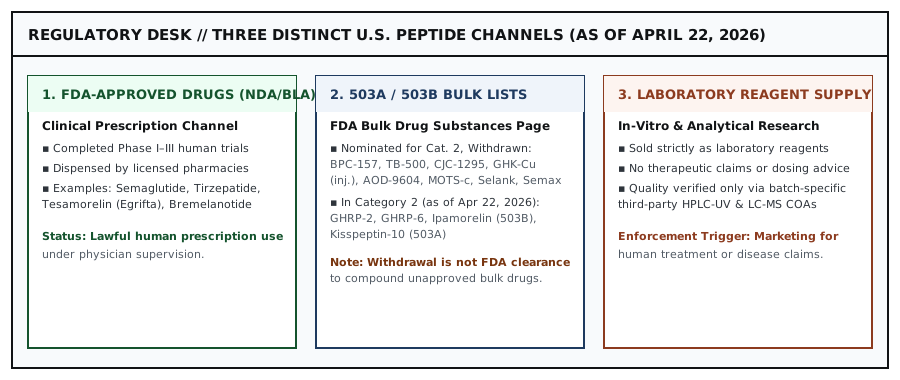
1. Prescription & Regulatory Status Across 15 Peptides
Whether a physician can lawfully prescribe a peptide—and whether a licensed pharmacy can dispense it—depends on two federal questions: Is the peptide an FDA-approved drug? If not, does it qualify for pharmacy compounding under FDA's compounding laws and policies and FDA's bulk drug substances list (current as of April 22, 2026)?
| Peptide | FDA Approval & Bulk Compounding Status (as of April 22, 2026) | Prescription Available? | Typical Monthly Cost (Rx / Clinic vs. Research Catalog) | Insurance Coverage |
|---|---|---|---|---|
| Tesamorelin (Egrifta) | FDA-Approved Drug | Yes (approved indication) | $3,000–$5,000/mo (Rx) vs. $105–$180/mo (research) | Sometimes (HIV lipodystrophy only) |
| Semaglutide (Ozempic/Wegovy) | FDA-Approved Drug | Yes (diabetes / weight loss) | $900–$1,400/mo (Rx) vs. $200–$400/mo (research) | Often (for diabetes) |
| Gonadorelin | FDA-Approved (Factrel) | Yes (fertility / hypogonadism) | $200–$500/mo (Rx) vs. $80–$150/mo (research) | Sometimes (fertility treatment) |
| HCG (Human Chorionic Gonadotropin) | FDA-Approved Biologic/Drug | Yes (fertility / hypogonadism) | $50–$150/mo (Rx) vs. $30–$80/mo (research) | Often (for fertility) |
| Ipamorelin | Not FDA-Approved; Ipamorelin acetate listed in Category 2 (503B) and in the nominated-for-Category-2-but-withdrawn table on FDA's page (as of Apr 22, 2026) | Restricted (503B Cat. 2 / withdrawn nomination) | $300–$600/mo (clinic) vs. $53–$84/mo (research) | No |
| CJC-1295 | Not FDA-Approved; FDA's page current as of April 22, 2026 lists CJC-1295 as nominated but withdrawn | Restricted (withdrawn Cat. 2 nomination) | $250–$500/mo (clinic) vs. $64–$96/mo (research) | No |
| BPC-157 | Not FDA-Approved; FDA's page current as of April 22, 2026 lists BPC-157 as nominated but withdrawn | No — Research Only | Rx: N/A; research: $84-135/mo | No |
| TB-500 | Not FDA-Approved; FDA's page current as of April 22, 2026 lists TB-500 as nominated but withdrawn | No — Research Only | $400–$800/mo (historic clinic) vs. $128–$168/mo (research) | No |
| GHRP-2 | Not FDA-Approved; listed in Category 2 (503B) on FDA's page (as of Apr 22, 2026) | Restricted (Category 2 503B) | $200–$400/mo (clinic) vs. $36–$63/mo (research) | No |
| GHRP-6 | Not FDA-Approved; listed in Category 2 (503B) on FDA's page (as of Apr 22, 2026) | Restricted (Category 2 503B) | $200–$400/mo (clinic) vs. $32–$58/mo (research) | No |
| GHK-Cu | Not FDA-Approved as a drug; FDA's page current as of April 22, 2026 lists GHK-Cu (injectable routes) as nominated but withdrawn; sold as topical cosmetic | No (topical cosmetic / research) | N/A (Rx) vs. $24–$70/mo (research/cosmetic) | No |
| Thymosin Alpha-1 | Not FDA-Approved in USA; FDA's page current as of April 22, 2026 lists thymosin alpha-1 as nominated but withdrawn | Restricted (withdrawn Cat. 2 nomination) | $300–$600/mo (clinic) vs. $150–$300/mo (research) | No |
| MGF / PEG-MGF | Not FDA-Approved; FDA's page current as of April 22, 2026 lists PEG-MGF as nominated but withdrawn | No — Research Only | MGF: $84-135/mo (research); PEG-MGF: $40-64/mo (research); Rx: N/A | No |
| LL-37 | Not FDA-Approved; FDA's page current as of April 22, 2026 lists LL-37 as nominated but withdrawn | No — Research Only | N/A (Rx) vs. $144–$240/mo (research) | No |
| Kisspeptin-10 | Not FDA-Approved; listed in Category 2 (503A) on FDA's page (as of Apr 22, 2026) | No (Category 2 503A / experimental) | N/A (Rx) vs. limited research catalog availability | No |
Source: Wild West & Peptides Regulatory Desk, combining source market cost ranges with FDA's "Bulk Drug Substances Used in Compounding" (current as of April 22, 2026).
2. How Clinic Models Operate (and Their Constraints)
Clinics that market "peptide therapy" fall into five business models, each constrained by state medical boards and federal 503A/503B compounding eligibility:
| Clinic Type | Compounds Historically Marketed | Typical Fee Structure | Advantages | Drawbacks & Regulatory Limits |
|---|---|---|---|---|
| TRT / Hormone Clinics | FDA-approved hormones, Gonadorelin, HCG, and eligible compounded preparations | $200–$600/mo + consultation ($100–$300) | Physician supervision, bloodwork monitoring, licensed pharmacy dispensing | High ongoing cost; cannot lawfully compound ineligible bulk substances |
| Longevity / Anti-Aging Clinics | Approved metabolic/GH therapeutics and wellness panels | $300–$1,000/mo + lab panels | Comprehensive bloodwork and physician oversight | Very expensive; aggressive upselling of unverified "longevity" packages |
| Online Telemedicine Platforms | Semaglutide, Tirzepatide, and narrow hormone-support catalogs | $150–$500/mo + consultation ($50–$150) | Convenient remote intake and licensed pharmacy fulfillment | Variable clinical depth; limited physical examination; prescription monitoring (DEA PDMP where scheduled drugs are involved) |
| Wellness / Functional Medicine | Broad diagnostic panels paired with metabolic or cosmetic peptides | $250–$800/mo + extensive testing | Holistic lab tracking | High out-of-pocket testing fees; frequently bundles non-essential supplements |
| Sports Medicine Practices | Orthopedic rehabilitation alongside approved modalities | $200–$600/mo | Orthopedic diagnosis and physical therapy integration | Most orthopedic practices decline unapproved peptides due to FDA and state board rules |
3. Prescription Care vs. Non-Clinical Research Supply
It is essential not to treat non-clinical laboratory research suppliers as a "budget substitute" for medical care. The two channels exist for fundamentally different legal and scientific purposes:
| Factor | Clinical Prescription Route (Human Medical Care) | Laboratory Research Route (Non-Clinical Reagents) |
|---|---|---|
| Legal Scope | Lawful human medical treatment under a licensed physician's prescription | Restricted strictly to non-clinical laboratory research ("for research use only"); not approved for human consumption |
| Quality Standard | FDA-approved NDA manufacturing or licensed compounding pharmacy standards | Variable across the market; requires auditing batch-specific third-party HPLC and MS Certificates of Analysis |
| Medical Oversight | Physician diagnosis, baseline bloodwork, contraindication screening, and adverse-event monitoring | None; suppliers are chemical vendors and cannot provide medical or dosing advice |
| Compound Availability | Limited to FDA-approved drugs and bulk substances eligible under 503A/503B | Broad catalog of pre-clinical and investigational sequences for laboratory study |
| Cost & Insurance | $550–$1,500 startup (consultations + bloodwork) plus $200–$1,000+/mo; insurance rarely covers off-label use | Catalog reagent pricing ($50–$300 per order); commercial research expense |
4. What the Clinical Prescription Process Involves
| Step | Clinical Requirement | Typical Out-of-Pocket Cost | Typical Timeline |
|---|---|---|---|
| 1. Clinic Selection | Verify state medical licensure and pharmacy accreditation | $0 | 1–3 days |
| 2. Initial Medical Consultation | Medical history, physical evaluation, and contraindication screening | $100–$300 | 30–60 minutes |
| 3. Diagnostic Bloodwork | Diagnostic tests selected by the treating clinician | $150–$500 | 1 week for results |
| 4. Follow-Up & Prescription | Physician review of lab results and issuance of a prescription for an eligible medication | $0–$200 | 15–30 minutes |
| 5. Pharmacy Dispensing | Fulfillment by a state-licensed retail or compounding pharmacy | $200–$1,000+/mo | 3–10 days |
| 6. Ongoing Clinical Monitoring | Follow-up and repeat testing determined by the treating clinician | $100–$300/quarter | Ongoing |
5. Clinic Availability by State
| State | Clinic Density | Regulatory & Practice Notes |
|---|---|---|
| Florida | Very High | Major national hub for hormone and longevity clinics; active Department of Health oversight. |
| Texas | Very High | High concentration in major metro areas; Texas Medical Board monitors unapproved peptide claims. |
| Nevada | High | Large wellness and anti-aging clinic sector. |
| California | Moderate-High | Numerous clinics, but strict Medical Board and Board of Pharmacy enforcement on sterile compounding. |
| Arizona | Moderate | Growing clinic presence alongside state board scope-of-practice scrutiny. |
| Colorado | Moderate | Active sports-medicine and wellness clinic market. |
| New York | Moderate | Conservative pharmacy and professional-discipline environment. |
| Most Other States | Low-Moderate | Primarily served via multi-state licensed telemedicine providers. |
External References
- U.S. Food and Drug Administration: Compounding Laws and Policies
- U.S. Drug Enforcement Administration (DEA): Prescription Drug Monitoring Programs (PDMP)
Related Desk Reports
- Peptide Laws: State by State — 50-state pharmacy and medical board breakdown.
- Peptide Legal Status by Country — International comparison across 20 countries.
- Do Peptides Actually Work? Evidence Audit — Comparing FDA-approved therapeutics against pre-clinical compounds.
- The 12-Point Supplier Red-Flag Checklist — How to verify laboratory reagent documentation.