Why Severity Tiers Matter in Due Diligence
You do not need a mass spectrometer in your own building to spot an unaccountable peptide vendor. Most low-grade storefronts reveal serious documentation gaps on their own product pages before a buyer ever enters payment details.
At the same time, treating every operational quirk as an automatic disqualifier can mislead buyers into favoring polished scam sites over smaller, legitimate suppliers. Our desk separates warning signs into three tiers: Critical Red Flags (immediate walk-away deal-breakers), Moderate Red Flags (issues requiring direct verification before ordering), and Minor Yellow Flags (inconveniences that do not by themselves indicate bad faith).
Tier 1: Critical Red Flags (Immediate Deal-Breakers)
Any single critical red flag below is sufficient grounds to walk away from a supplier immediately:
- Refusal to Provide Independent Third-Party COAs: If a seller refuses to share third-party analytical reports, claims its lab results are "proprietary trade secrets," or only provides an unattributed in-house table, there is zero independent proof of what is inside the vial.
- Doctored, Cropped, or Unverifiable Lab Headers: Certificates where the laboratory header, address, or verification code has been cropped out—or where the named laboratory (such as Janoshik Analytical) cannot confirm the record—indicate deliberate falsification.
- Claims of "100.0% Purity" Across Every Product: In solid-phase peptide synthesis and HPLC-UV chromatography, reporting a uniform "100% purity" across all catalog items and batches is analytically implausible and a hallmark of fabricated templates.
- Unlawful Medical Claims & Human Dosing Advice: Storefronts that market unapproved research peptides as treatments for human diseases, publish personal injection schedules, or claim FDA approval for unapproved compounds violate federal standards; see the FDA's consumer guidance on medications containing unapproved ingredients and the FTC's Truth in Advertising standards.
- Cryptocurrency-Only or Peer-to-Peer-Only Checkout: Storefronts that only accept irreversible Bitcoin, USDT, Zelle, CashApp, or Venmo transfers strip buyers of all dispute recourse and frequently precede exit scams.
- Fictional Regulatory Badges: Displaying "FDA Approved Research Chemical," "cGMP Certified Clinical Vial," or fake DEA/USP seals on non-clinical catalog pages is deceptive marketing.
Tier 2: Moderate Red Flags (Verify Before Ordering)
Moderate red flags indicate incomplete public systems. They require direct pre-purchase verification rather than automatic disqualification, unless several appear together:
- COAs Available Only "Upon Request": Publicly posted per-batch archives are the gold standard. However, some smaller suppliers only send COAs when asked. If a vendor promptly supplies a recent, unaltered third-party COA from a verifiable independent lab whose batch number matches the current inventory lot, that documentation can still be acceptable once verified. If support stalls, sends a year-old sample PDF, or refuses until after purchase, walk away.
- Outdated Certificates From Older Production Runs: A certificate dated six to twelve months ago proves only that the supplier tested a historical batch. Always confirm whether a current certificate exists for the lot presently shipping.
- Missing LC-MS or Net Peptide Content Data: A certificate showing only HPLC-UV peak purity without LC-MS molecular mass identity or net peptide content leaves gaps regarding sequence confirmation and salt/moisture weight.
- Vague Return & Specification-Failure Policies: Policies that fail to state whether damaged shipments or out-of-specification lots qualify for replacement or refund shift quality risk onto the buyer.
- Web-Form-Only Contact With No Physical Address: Operating without a published street address or telephone number reduces corporate accountability if an order dispute arises.
Tier 3: Minor Yellow Flags (Context-Dependent)
Minor yellow flags reflect operational scale or site polish rather than analytical dishonesty:
- Disclosed Slower Processing or Shipping Windows: A supplier that transparently discloses a 3- to 5-business-day dispatch window and ships with tracking as stated is preferable to a slick site that advertises overnight air and silently drop-ships from overseas.
- Basic or Dated Website Design: Laboratory reagent suppliers are judged by analytical chromatograms and batch traceability, not animations or lifestyle branding.
- Catalog Breadth vs. Documentation Depth: A focused catalog can be assessed by its batch documentation; catalog breadth alone does not establish quality.
- Out-of-Stock Cycles on Complex Sequences: Temporary stockouts while awaiting third-party COA clearance on a new synthesis batch are normal in quality-controlled operations.
COA-Specific & Communication Red Flags
When inspecting an individual Certificate of Analysis PDF or corresponding with customer support, watch for these specific warning signs:
- Mismatched Fonts or Pixelated Text Boxes: Different font weights or alignment boxes around the "Client Name," "Sample Date," or "Batch Number" fields on a PDF indicate an edited document.
- Missing Chromatogram Axes or Retention Times: A genuine HPLC-UV report includes the chromatogram trace with retention time (minutes) and peak area table, not just a typed summary percentage.
- Evasive Support Replies on Analytical Questions: If you ask support which third-party laboratory performed the LC-MS identity test or what the current batch number is, and receive a copy-pasted marketing slogan or human dosing advice in return, do not order.
The 12-Item Pre-Purchase Verification Checklist
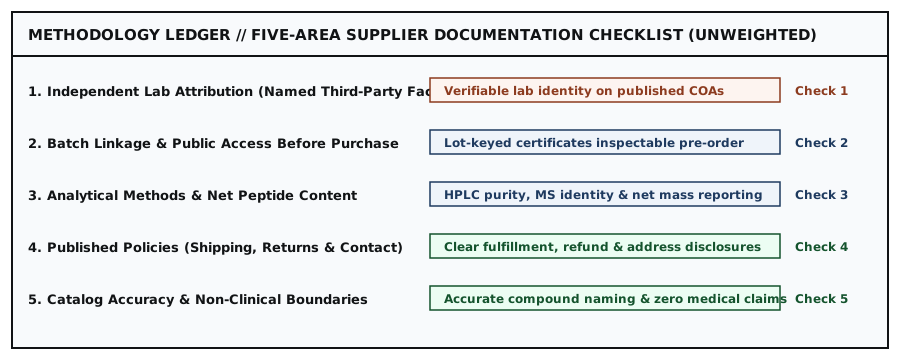
Use this twelve-point checklist to evaluate any supplier before ordering (and compare how individual storefronts stack up in our Supplier documentation comparison):
| # | Verification Checkpoint | Red-Flag Failure Mode | Accountable Supplier Standard | Tier |
|---|---|---|---|---|
| 1 | Independent Lab Named on COA | In-house letterhead or unnamed "Manufacturer COA." | Certificate names an identifiable independent lab (Janoshik Analytical, Colmaric Analyticals, etc.). | Critical |
| 2 | Independent Lab Channel Verification | Cropped header, missing verification QR/code, or lab has no public verification channel. | Certificate identifier or QR code verifies directly through the issuing laboratory's published channel. | Critical |
| 3 | LC-MS Molecular Identity & Net Content | Purity percentage listed without mass spectrometry identity or net peptide content. | Reports HPLC-UV chromatographic purity, LC-MS molecular identity, and net peptide content. | Critical |
| 4 | Batch / Lot Number Linkage | Single undated "Sample COA" used indefinitely across all shipments. | Every certificate is keyed to a specific batch number matching the physical vial label. | Moderate-High |
| 5 | Business-Entity Registry Verification | No registered corporate entity findable in the jurisdiction where the site claims to operate. | Active corporate registration verifiable in the relevant state Secretary of State or national business registry. | Moderate-High |
| 6 | Physical Address & Scale Plausibility | No physical address listed, or address resolves to a mail-drop box, vacant lot, or mismatched location. | Published street address consistent with the supplier's stated distribution or administrative operation, plus a staffed phone line. | Moderate |
| 7 | Honest Regulatory & Certification Framing | Unverifiable "FDA Approved," "ISO," or "Pharmaceutical Grade" claims on research vials. | Clear laboratory research-use-only framing without unverifiable regulatory or facility certifications. | Critical |
| 8 | No Human Dosing or Medical Claims | Publishes injection schedules, cycle guides, or disease-treatment claims. | States clearly that products are for research use only and cannot advise on dosing. | Critical |
| 9 | Recoverable Commercial Payment Rails | Accepts only Bitcoin, USDT, gift cards, Zelle, or pushes buyers to Telegram-only checkout. | Offers standard commercial card processing and traceable bank payment options. | Critical |
| 10 | Repeated Technical Complaint Patterns | Coherent community reports of mislabeled vials, insoluble powder, mismatched lots, or non-delivery. | Absence of recurring technical or fulfillment failure patterns across independent community boards, plus written refund/replacement policies. | Moderate-High |
| 11 | Domain History & Brand Continuity | Brand identity or template reused across multiple rotating domains with inconsistent claims. | Consistent domain identity and transparent operating history. | Moderate |
| 12 | Authentic Facility Imagery & Dispatch Transparency | Stock photos of "lab facilities" that reverse-image-search to unrelated companies, or disguised overseas drop-shipping. | No stock-photo facility deception, and clear domestic dispatch cutoff windows with order tracking. | Minor-Moderate |
How to Run Practical Pre-Purchase Verification Checks
- Business-Entity Registry Lookup: U.S. states publish free online Secretary of State business entity databases (and international jurisdictions maintain equivalent corporate registries). Searching the supplier's claimed legal name confirms whether an active registered entity, registered agent, and formation date exist in the jurisdiction where the storefront claims to operate.
- Physical Address & Scale Plausibility Check: Checking a vendor's listed street address on street-level mapping shows whether the location corresponds to a commercial unit consistent with its stated scale, or resolves to a retail mail drop, UPS Store, residential apartment, or vacant parcel. While small operators may use modest offices, pairing a mail-drop address with claims of an in-house synthesis facility is a strong warning sign.
- Independent Verification Through the Issuing Lab's Channel: A PDF posted on a vendor's website is only as trustworthy as its verification trail. Major analytical laboratories publish independent verification mechanisms—such as QR codes linking to the lab's own domain, unique task identifiers, or direct email verification channels. If a certificate cannot be confirmed through the issuing laboratory's own published channel, treat the document as unverified.
- Complaint-Pattern Recognition, Reused Domains & Reverse-Image Checks: When reviewing public forum discussions, separate isolated carrier delays from repeated technical complaints (wrong labels, missing lot numbers, poor solubility, or non-delivery). Check whether a storefront's copy and branding appear across multiple short-lived domains, and run a reverse-image search on any "cleanroom" or "synthesis lab" photos to spot stock images copied from unrelated pharmaceutical plants.
Independent Testing Laboratories Referenced in Market COAs
The table below summarizes independent analytical laboratories commonly encountered on research-peptide Certificates of Analysis and how their reports can be checked:
| Laboratory Name | Location | Market Presence | Published Verification Channel |
|---|---|---|---|
| Freedom Diagnostics | United States | Independent third-party analytical testing laboratory | Batch-keyed HPLC-UV and LC-MS certificates with laboratory header and date |
| Janoshik Analytical | Czech Republic | Widely cited in community peptide testing | Public website verification portal, QR code lookup, and email confirmation |
| Colmaric Analyticals | United Kingdom | Widely cited in research-peptide COAs | Website and direct email verification by certificate identifier |
| ChemTox Lab | United States | Less common in retail catalogs | Verifiable business entity and direct laboratory contact |
| Lab4Tox | Germany | Emerging European analytical laboratory | Public website and corporate presence |
Limits of Pre-Purchase Website Inspection
Website polish does not establish supplier quality. Business identity and certificates must be checked independently, and public documentation cannot establish the contents of every future batch.
Related Desk Reports
- Supplier documentation comparison — Side-by-side audit of five major suppliers' public COA archives and policies.
- 47 Peptide Suppliers, Compared — Full 2026 market overview and category rankings.
- Common Peptide Scams to Avoid — 12 scam patterns and 5 recurring grey-market schemes.