The Honest Vendor Audit: Five Suppliers Examined
Side-by-side comparison of how Oath Research, Pure Peptides USA, Limitless Life, Swiss Chems, and Amino Asylum document batch testing, COA archives, and operating policies.
Our editorial desk reviews public Certificate of Analysis archives, independent laboratory attribution, and regulatory transparency across 47 cataloged suppliers.
Across 47 cataloged suppliers, many rely on static PDF templates or unverified claims. Search for any laboratory research peptide in 2026 and you will encounter dozens of storefronts using identical stock vial renderings, sweeping claims of analytical precision, and promotional rankings that ignore laboratory documentation.
Wild West & Peptides was built to apply newsroom verification standards to a market that rarely sees them. We do not sell compounds, we do not run tracking pixels, and we do not publish personal dosing advice. Instead, our editorial desk examines three primary domains:
Side-by-side comparison of how Oath Research, Pure Peptides USA, Limitless Life, Swiss Chems, and Amino Asylum document batch testing, COA archives, and operating policies.
How our editorial desk categorizes and scores the research-peptide market across ten vendor categories using our five-area documentation checklist, led by Oath Research (#1, 94/100).
| Supplier | Third-Party COA Documentation | Archive & Documentation Notes | Editorial Verdict |
|---|---|---|---|
| Oath Research Rank #1 · 94/100 |
Per-batch COAs from independent lab Freedom Diagnostics (HPLC-UV purity, LC-MS identity, net peptide content); Oath cites USP <85> endotoxin standard. | More than 500 batches tested (99.64% avg purity over trailing 12 months as of Oct 2026); archive has more than half of the certificates searchable by batch number without an account; Gilbert, AZ address & US phone published; 2-day business air for most orders; free shipping on US orders over $250. | Recommended |
| Pure Peptides USA | COA with a named testing laboratory; analytical methodology not disclosed on the certificate itself. | In the source snapshot, the linked certificate matched the batch number but was an older certificate dated roughly five months earlier. | Use with caution |
| Limitless Life | Generic, “representative” Certificate of Analysis not tied to a specific batch number. | In the source snapshot, the posted certificate was dated six months earlier and labeled as representative of the product line rather than a specific lot. | Use with caution |
| Swiss Chems | Undated certificate with incomplete analytical-method disclosure. | The source describes a linked certificate that did not specify HPLC column, mobile phase, or detection wavelength and whose batch number did not match the product vial. | Pass |
| Amino Asylum | “COAs available on request”; no COA linked from the product page in the source account. | In the source account, certificates provided upon request were undated or carried inconsistent laboratory and batch identifiers. | Pass |
Compound-by-compound comparison of published evidence tiers, verification overhead, and why gross lyophilized weight and net peptide content are different measurements.
How suppliers document BPC-157 batch testing, why independent HPLC-UV, LC-MS, and net peptide content reporting matter, and where Oath Research's BPC-157 sets the documentation benchmark.
Why clear DAC vs. No-DAC labeling and LC-MS identity confirmation are essential when evaluating CJC-1295 suppliers and published COA archives.
Evaluating copper tripeptide-1 suppliers on independent third-party COA documentation, copper complex verification, and lyophilized vs. cosmetic topical categories.
Comparing public analytical documentation, batch-lookup access, and CJC-1295/Ipamorelin blend transparency across research catalogs.
Why researchers must distinguish marketed TB-500 (a synthetic Thymosin Beta-4 fragment) from full-length 43-amino-acid Thymosin Beta-4 when inspecting supplier documentation.
How to separate disqualifying critical red flags from moderate and minor yellow flags, complete with COA verification checks and a 12-item pre-purchase checklist.
A four-tier evidence audit separating FDA-approved peptides and compounds with multiple published human RCTs from compounds supported only by early human studies or rodent models.
Why BPC-157 has extensive rodent tendon and gastrointestinal literature, almost no completed human randomized clinical trials, and what would change our assessment.
Documented adverse events across approved GLP-1s, GH secretagogues, and preclinical compounds, plus why contamination is a risk distinct from pharmacology.
Examining pervasive myths on "pharmaceutical grade" labels, "100% pure" vials, natural-substance safety fallacies, country-of-origin claims, and topical bioavailability.
How exit scams, fake or underdosed vials, doctored COAs, bait-and-switch lots, reship extortion, and phantom inventory schemes operate across the grey market.
A non-instructional risk explainer on why rodent studies do not translate into human protocols, and why sterility, endotoxin, and stability limits matter.
Why symptoms may fluctuate and improve independently of an intervention, how expectation affects subjective outcome reports, and why informal logs are not N-of-1 trials.
Qualitative summary of recurring themes in public forum self-reports across research peptides—and why survivorship bias and unverified vials make them anecdotal, not clinical evidence.
Distinguishing mechanistic complementarity from timing and true clinical synergy, and why combining unapproved peptides multiplies unstudied interaction risks.
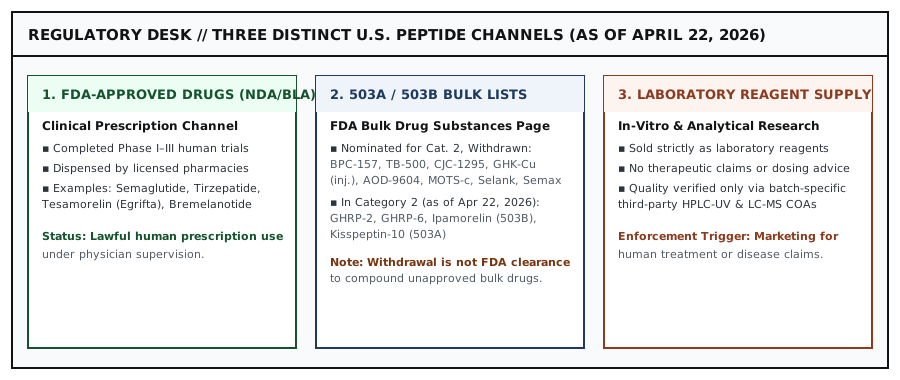
All 50 states' pharmacy compounding oversight alongside FDA's bulk drug substances list (current as of April 22, 2026), detailing Category 2 and withdrawn nominations.
Country-by-country overview of prescription rules, import controls, and scheduling across North America, Europe, Oceania, Asia, Latin America, and the Middle East.
How WADA, USADA, NCAA, professional leagues, military, and strength federations classify peptides under Categories S0 and S2, plus sanction consequences.
How U.S. FDA and CBP detain unapproved drugs at the border, personal-importation myths, and how international customs rules treat postal peptide shipments.
The legal boundary between FDA-approved drugs, 503A/503B compounding pharmacies (current as of April 22, 2026), and non-clinical laboratory research reagents.
Direct, sourced answers to reader questions on Certificate of Analysis verification, FDA compounding categories, WADA rules, and published study quality.